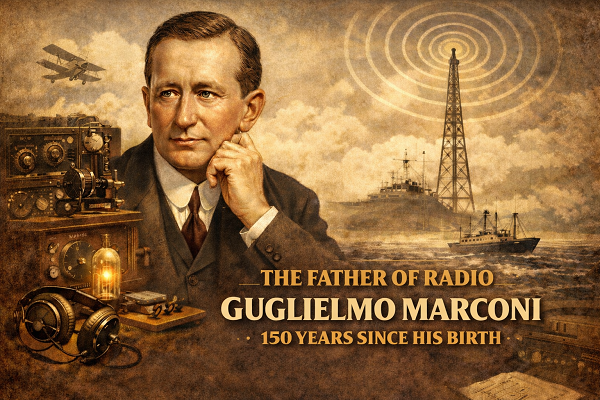
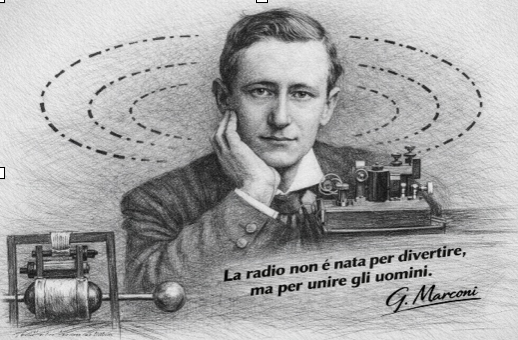
My Simple Way of Remembering Marconi
Talking about Guglielmo Marconi has always felt natural to me.
I was born eighty-five years after him, in a fast-paced world that takes everything for granted. Yet, every time I think of the radio, his name comes to mind as if he were a nearby presence, almost familiar.
I can't say when it all started.
I only know that since I got into radio communications, I've felt that behind every signal, there was a bit of him too. Not as a "father" in the classical sense, but as someone who paved a path and left it there, ready for those who would come after.
Marconi dedicated his life to something that seemed impossible at the time: making a voice travel through the air. And I, born much later, feel part of that gesture every time I turn on the radio.
It's a simple but strong feeling: as if I am continuing a dialogue started more than a century ago.
It’s now April, the month in which he was born.
And during this period, it comes naturally to remember him. Not with grand speeches, but with a quiet melancholy, the kind that comes when you think of someone you've never met but who, in some way, changed your life.
When I send out a CQ, when I hear a rustle, when I hear a distant voice, it always feels like paying a small tribute to him.
A way to say: "I am here, and I continue what you started."
... ... ... An Inevitable Brief Timeline of Guglielmo Marconi
1874, April 25th Born in Bologna, at the family villa in Pontecchio.
1894 - Begins experiments on wireless telegraphy inspired by the works of Hertz, Lodge, and Righi.
1895 - Conducts the first long-distance connections in the villa’s park, surpassing the famous hill of Celestini: the first radio signal beyond a natural obstacle.
1896 - Submits his first patent on wireless telegraphy to the London Patent Office.
1897 - Founding of the Wireless Telegraph & Signal Company, with the first public demonstrations and operational installations.
1898 - First radiotelegraph service on a passenger ship: RMS Lucania.
1899 - First radio connection across the Channel: from Dover (UK) to Wimereux (France). Radio coverage of the rescue of the steamer R.F. Matthews.
1901 - Reception of the first transatlantic signal: the letter “S” in Morse from Poldhu (Cornwall) to St. John’s (Newfoundland).
1902 - Development of the improved coherer detector and first experiments with directional antennas.
1904 - Introduction of the crystal detector (galena detector), more sensitive and reliable.
1909 - Nobel Prize for Physics, shared with Karl Ferdinand Braun.
1912 - The Marconi system is crucial in the Titanic's rescue communications.
1914/1918 - During World War I, works on shortwave systems and military communications.
1923/1924 - Development and refinement of shortwave with directional antennas: the birth of modern long-distance radio.
1931 - Experiments with microwaves and narrow-beam radio links.
1935 - Public demonstrations of radar-locating, precursor to radar.
1937 July 20 Dies in Rome.
Radio stations around the world observe a minute of radio silence in his honor.
I don't need complex words; this is enough for me:
Marconi is the reason why today I can speak to the world, even alone, in a silent room.
73’ de Giorgio, IZ3KVD